A Virtual Visit to CERN
Friday 13 February, 10:30–11:30
📍 Online (live from UCLan London, Rooms 603 & 604)
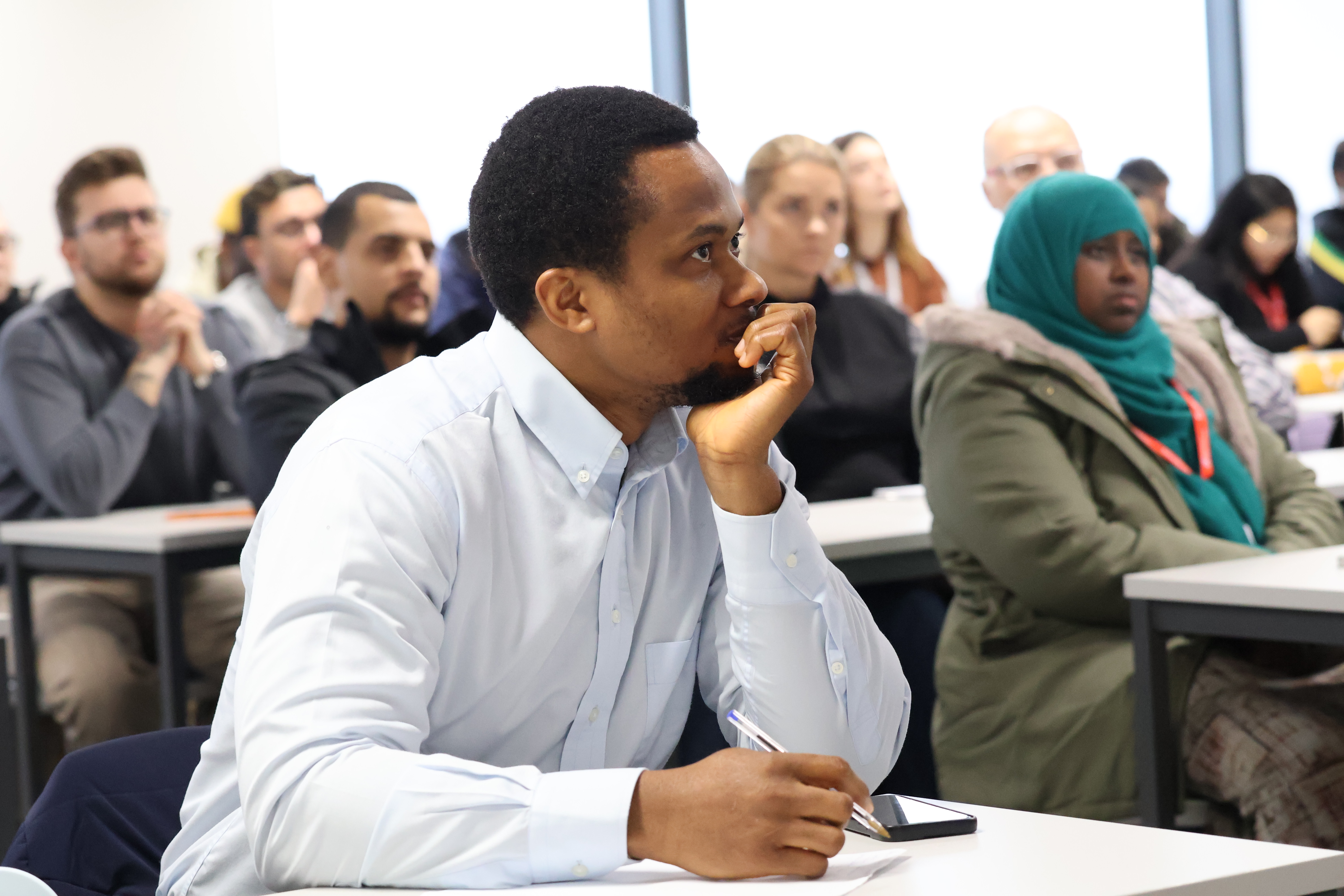
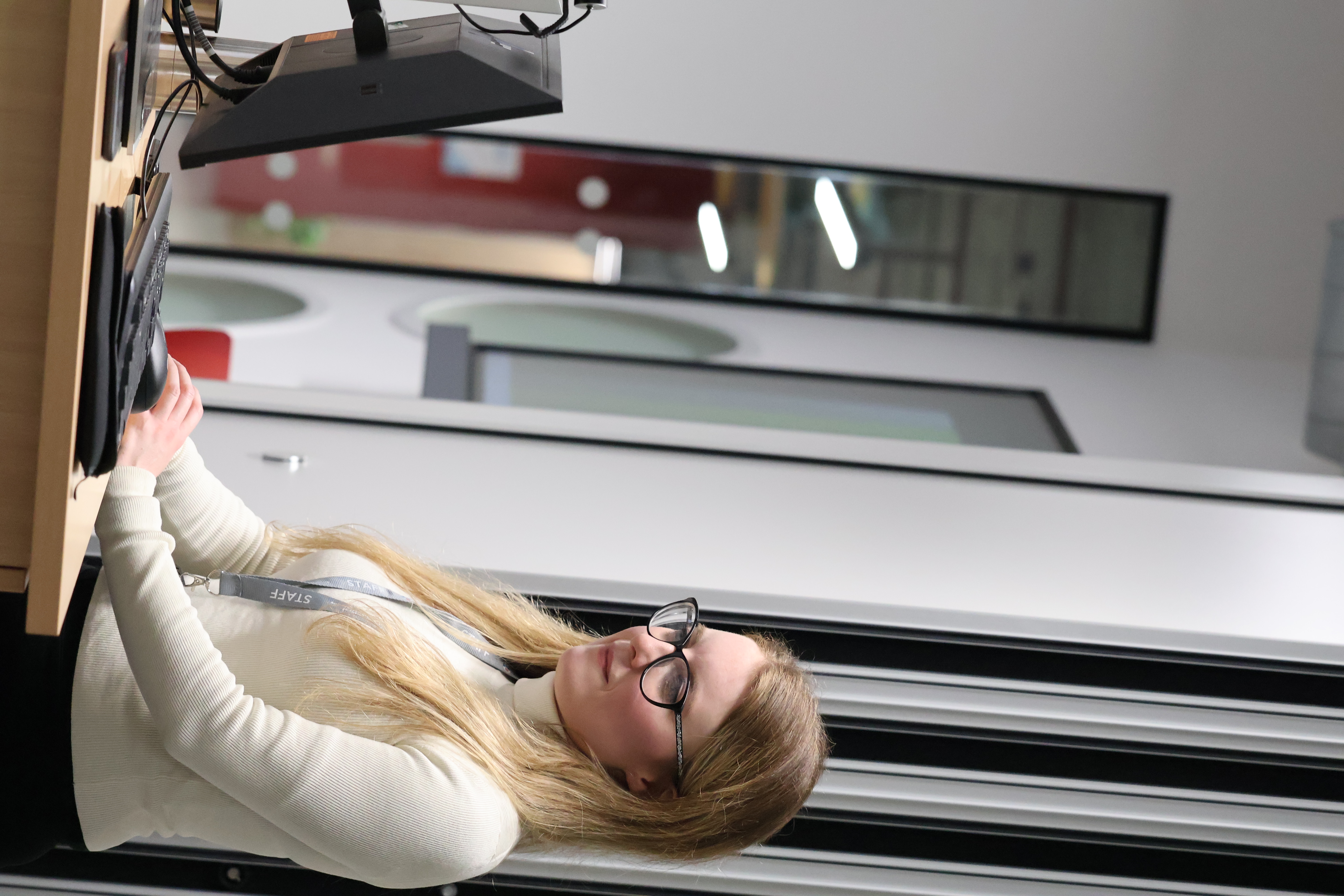
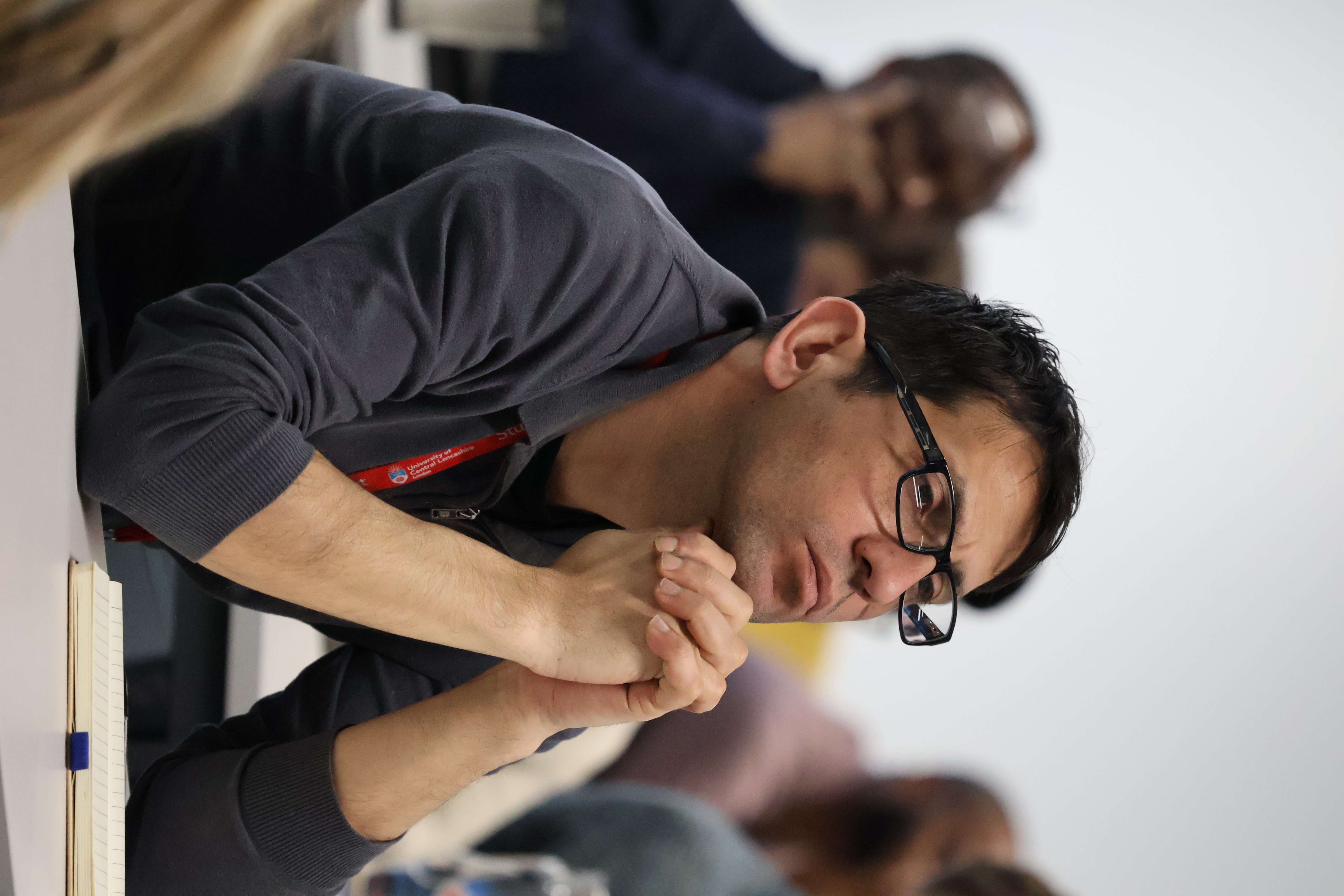
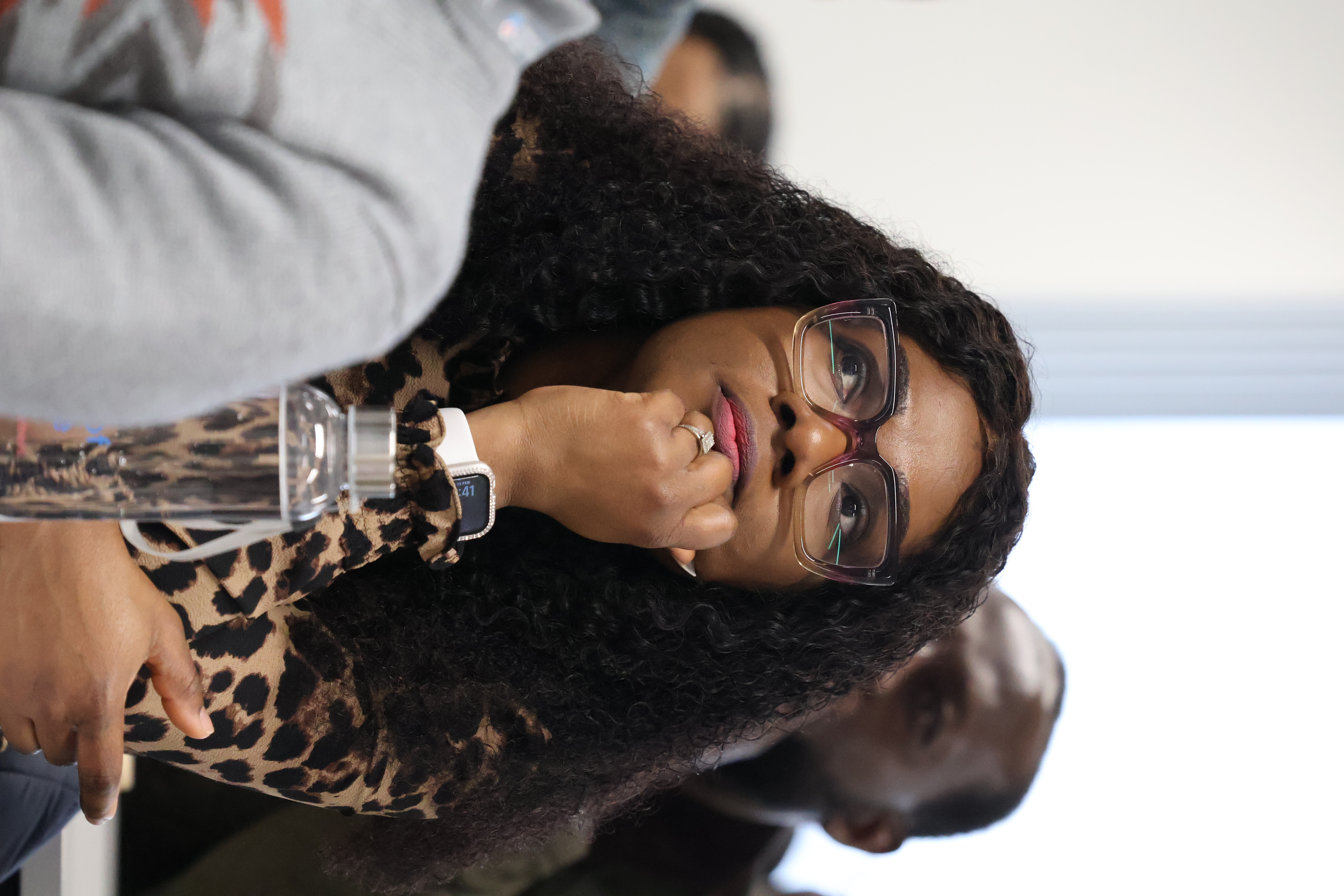
Students and staff from UCLan London recently took part in an engaging virtual visit to CERN, the European Organisation for Nuclear Research based near Geneva, Switzerland. Founded in 1954, CERN is one of the world’s leading centres for particle physics research and is widely known as the birthplace of the World Wide Web.
About the session
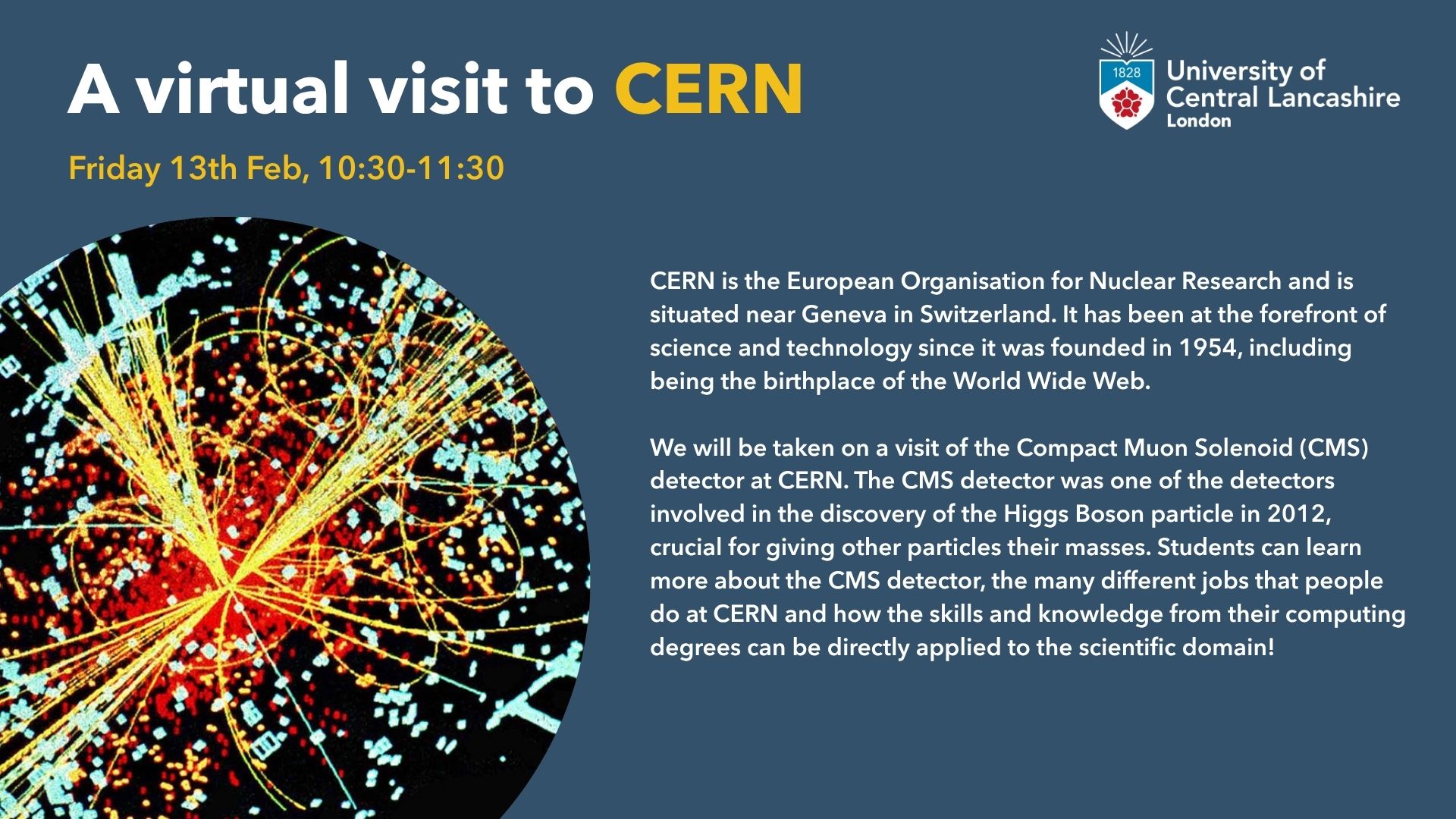
During this live virtual visit, students were given a guided tour of the Compact Muon Solenoid (CMS) detector at CERN. The CMS detector played a key role in the discovery of the Higgs boson in 2012, a breakthrough that helped explain how particles acquire mass.
What students have learnt
- How the CMS detector works and why it is critical tomodern particle physics
- How data from particle collisions is collected and analysed
- The wide range of careers at CERN, beyond physics alone
- How skills from computing and related degrees aredirectly applied in cutting-edge scientific research
Kathryn Coldham
Lecturer (Computing)
"It was a pleasure to arrange for UCLan London students to be taken on a live virtual visit of Compact Muon Solenoid (CMS) detector at CERN! Tour guides Dr Claire Lee, Derek Grove and Zoltan Szillasi from the CMS Visits Team took students on an insightful journey into how the CMS detector works, how data from particle collisions is collected and analysed and future particle physics plans. The event has shown how the skills gained from computing and related degrees can be directly applied in cutting-edge scientific research!"
Agnes Kosek
Lecturer and Academic Lead (Employability)
"As Kathryn indicated in her presentation, ancient philosophers have long sought answers to questions such as: what role does physics play in shaping our understanding of the world, and how did we arrive at our current state of knowledge? Many contemporary philosophers of education also ask how we might provide students with strong technological foundations and enable them to contribute to technological advances and be prepared for careers in a rapidly changing world. The CERN event, organised by Kathryn and operationalised by Anita Steinberg, was designed precisely to provide students with those important foundations, to stimulate their sense of awe and wonder, and to bring particle physics to life!"